Showing posts with label Discoveries. Show all posts

Monday, August 10, 2026

Winding the Mantel Clock: Angelo DeLio 1880-1944

In the late nineteenth century, mass migration from Italy accelerated. Chicago’s foreign-born Italian population grew from 16,008 in 1900 to a peak of 73,960 in 1930. Most of these newcomers were peasants—contadini—from the southern regions, especially Basilicata, Campania, and Sicily. Drawn by the demand for railroad workers, many were enrolled in work gangs by padrones and sent to construction sites across the country. Once men found steadier work in the city’s public works and industries, they sent for their wives and children. Women often took jobs in the sweatshops and factories of the garment trade.

This is the world my grandfather, Angelo DeLio, entered as a child.

Life in Italy

Angelo was born on March 13, 1880, in the village of Gesuiti, part of the municipality of San Vincenzo La Costa in the province of Cosenza, Calabria. Family lore claims the hamlet was so small that a person could yell from one end to the other and be heard clearly. Even today the population hovers around 370, so the story may not be much of an exaggeration.

His parents, Carmela Perri and Raffaele DeLio (Ralph, as he was later called), were farm laborers. Opportunities in such a place were scarce. Between 1880 and 1920—the height of Italian migration to the United States—roughly four million Italians, the majority from the South, arrived looking for work they could not find at home. After unification, factories and wealth concentrated in the North while the South remained largely agricultural. Many southern farms were owned by northern landlords who offered terms similar to those of post-Civil War sharecropping in America. High taxes, low wages, recurring drought, and scarce water made life even harder. Over the longer period from unification into the mid-twentieth century, an estimated 26–29 million Italians left the country (roughly a quarter of the population at the time of unification), with the heaviest waves occurring from the 1880s through the 1920s.

In the late 1800s a mysterious parasite destroyed most of the grapevines in southern Italy, pushing many farms into failure. Unemployment rose, skilled workers lost their livelihoods, and cholera and malaria swept through the region. Early in the twentieth century came a series of natural disasters—eruptions of Mount Etna and Mount Vesuvius among them. Like so many others, Ralph went ahead to the United States to establish a foothold before sending for his wife and young son.

Arrival in America                                                  

1. SS Bolivia


On January 4, 1888, the SS Bolivia arrived in New York from Naples. Seven-year-old Angelo traveled with his mother, listed as Ma Carmella Perri. A notation on the passenger list records 777 Italian aliens in third-class steerage. Three weeks at sea in crowded conditions would have been difficult for any adult; for a small boy leaving behind everything he knew, and doing so around Christmastime, it is hard to imagine.

2. The Battery & Castle Garden Immigration Center - N.Y.


Whether they landed at Castle Garden or Ellis Island is not entirely clear from surviving documents. Castle Garden operated from 1855 until April 1890; Ellis Island opened in 1892. A fire on Ellis Island in 1897 destroyed many earlier records, including those from the Castle Garden era. Given the date of their arrival, Castle Garden is the more likely port of entry.


3. Chicago street map, 1890s  - University of Chicago

How the family made its way from New York to Chicago remains unknown. The 1890 federal census, which would have been the first to record them, was largely destroyed by fire in 1921, and the remaining damaged records were later disposed of by government order. What is certain is that the DeLios settled in Chicago’s Little Italy and stayed.

Little is known of Angelo’s childhood. The 1900 census notes that he could speak English but could not yet read or write. By 1910 he could do both. Whether he taught himself or received some formal schooling is an open question.

On January 2, 1892, Carmela gave birth to Emilia Maria—Millie to the family. There was a twelve-year gap between Angelo and his sister. Census records indicate that Carmela had four children, only two of whom survived. Millie was the youngest.

4. State Street North of Madison-Chicago - 1890s

The 1890s were a remarkable decade in Chicago. The World’s Columbian Exposition opened in 1893. Prairie School architects such as Frank Lloyd Wright were gaining recognition. Theodore Dreiser began work on Sister Carrie. On the darker side, H.H. Holmes (Herman Mudgett) was operating his "Murder Castle" near the fairgrounds, and just before the exposition closed, Mayor Carter Harrison Sr. was assassinated.

Two years after the fair closed, on March 16, 1895, Angelo became a naturalized citizen. The naturalization record lists him as a minor living at 140 Sherman Street.


Building a Family

5.  Angelo DeLio - ca 1900


In June 1900, twenty-year-old Angelo lived at 180 West Polk Street with his parents and sister and worked as a day laborer. 


6. Pg from 1905 marriage registry —
Holy Guardian Angel Chicago


 By 1905 marriage was approaching. As was common, a match was arranged between Angelo's parents and the neighboring Lufrano family. Fourteen-year-old Maria (Mary) Lufrano, daughter of Michele (Mike) and Saveria Lufrano, married Angelo on January 15, 1905, at Holy Guardian Angel Church. 

The young couple moved in with Angelo’s parents on Polk Street. Before the decade ended, Mary gave birth to two sons: Carmine Raffaele (Carl, or Carmie), born April 17, 1906, and Michael Joseph (Mike or Mikey), born July 3, 1909. Both were baptized at the same church.


7. Holy Guardian Angel Church-Chicago


In 1910 the extended family—Ralph, Carmela, Millie, Angelo, Mary, and the two boys—moved to a second-floor apartment at 640 S. Sangamon Street. Mary’s uncle Frank and his family occupied the first floor; two boarders lived in the basement. 

In 1912 Mary gave birth to a daughter, Giuseppa (Josephine, or Josie), on July 26. The family soon moved to 712 S. Morgan Street. Most of these buildings are gone now, cleared for highway construction, a university campus, and medical facilities.

8. Angelo and Mary DeLio's DeKalb Street Rowhouse


Francesca Carmela (Francie) arrived on December 30, 1914, while the family lived at 711 S. Loomis—a rowhouse that still stands. 

Sometime in 1916 they made their final move together, to a house Angelo could now afford as a freight handler for the Baltimore & Ohio Railroad: 2129 W. DeKalb Street (later renamed Bowler Street). 

That rowhouse became the family homestead until around 1950. Inside its walls the two youngest children were born: Maria Saveria (Marilyn, or Mary within the family) on June 10, 1917, and Giovanni Angelo (John, or Johnny) on September 10, 1920.


The Later Years

                                                                                             9. DeKalb Street - Chicago


By the mid-to-late 1920s the older children were in school, bringing friends home, and beginning to date. My mother used to tell a story about those evenings. When it was time for the visitors—especially her sisters’ boyfriends—to leave, Grandpa would walk into the living room and begin winding the mantel clock. He never said a word. That single action was enough. The girls knew better than to argue; the young men said goodnight and went home. The sons were treated a little more leniently—though they were probably receiving the same silent signal at their girlfriends’ houses.

In June 1930 Carl married Catherine Citro. By the end of the decade all four of Angelo and Mary’s parents had died—Ralph DeLio and Michael Lufrano in 1928, Carmela DeLio and Saveria Lufrano in 1929. Then came the Great Depression. The lowest years, 1931–1933, brought high unemployment, poverty, and a general loss of confidence. Recovery would not truly arrive until around 1940.

Life continued as normally as it could until the later 1930s, when three more of the children married: Francie to Dominic Segreti in November 1936, Josie to Joe Lipari in September 1939, and Mike to Irene Urbaniak two months later.

War and Loss

Germany’s invasion of Poland on September 1, 1939, marked the beginning of World War II. The United States instituted the Selective Training and Service Act in September 1940. After Pearl Harbor, the draft expanded. On April 27, 1942, Angelo—then sixty-two, still working for the B&O Railroad—registered. His draft card describes him as five feet tall, 131 pounds, with a sallow complexion, gray eyes, and black hair.

Johnny served in the U.S. Army from 1942 to 1944 and saw action in and around Italy. During his service he married Lee Rodgers; the marriage ended about five years later. The last of the DeLio children to marry was my mother, Marilyn, who wed my father, Rocco Poppa, in July 1944. Angelo did not live to walk her down the aisle.

Shortly after registering for the draft, he was diagnosed with pancreatic cancer. He endured the illness for roughly two years and died on February 21, 1944, at the age of sixty-three.

I never knew my grandfather. From everything I have learned, he was a good man who left too soon. Researching his life has brought me closer to him. I wish I had uncovered more, but the clock has yet to run down, and until it does, my search continues.


Photo credits

  1. SS Bolivia (built 1873 by Robert Duncan & Company for the Anchor Line; transferred to the Glasgow–Naples–New York service in November 1887).
  2. Battery and Castle Garden, New York City. Photograph by William Henry Jackson; published by Detroit Publishing Co., ca. 1890–1897.
  3. Chicago street map, 1890s. University of Chicago Library.
  4. State Street north of Madison, Chicago, 1890s. Historic photograph (Detroit Photographic Co.).
  5. Angelo DeLio, ca. 1900. Author’s private collection.
  6. Page from the 1905 marriage registry of Holy Guardian Angel Church.
  7. Holy Guardian Angel Church, Arthington Street, Chicago. The Newberry Library.
  8. Angelo and Mary DeLio’s DeKalb Street rowhouse, 2019. Author’s private collection.
  9. DeKalb Street, Chicago, 2019. Author’s private collection.

Sources & further reading

  • Chicago Italian community and migration background: Encyclopedia of Chicago (“Italians”).
  • Broader Italian emigration statistics and southern Italian conditions: standard historical overviews of Italian Americans and Italian emigration (including figures commonly cited for the 1880–1920 peak to the United States and the longer 1861–mid-20th-century totals of roughly 26–29 million departures).
  • Chicago in the 1890s (World’s Columbian Exposition, architecture, literature, and the H. H. Holmes case): Donald L. Miller, City of the Century (Simon & Schuster, 1996); Erik Larson, The Devil in the White City(Random House, 2003).
  • Great Depression overview and World War II Selective Service details: commonly available historical summaries.

Family details, addresses, vital records, the mantel-clock anecdote, and personal reflections are drawn from census records, naturalization documents, church registers, draft cards, and family oral history.


Sunday, May 17, 2020

THANK YOU, GRANDPA...

My grandfather, Isidoro Poppa, died on 18 August 1923 in Bridgeport, Connecticut. He was only 31-years-old. He never got to see his children grow up, meet any of his 17 grandchildren, or hear any of them call him grandpa. At the time of his death, his oldest child was 12-years-old, and the youngest was less than one year. Isidoro is buried at St. Michael’s Cemetery in Stratford, Fairfield County, Connecticut. Sadly, there is no tombstone on his grave to mark his passing or to honor his life.

Isidoro Poppa was the second eldest out of the five children of Fedele and Elisabetta Branca Poppa. He was born on 4 April 1891, in Orsara di Puglia, Foggia, Italy. (Wikipedia Contributors, 2020) [1]

In the early 1900s, Italy suffered from poverty, overcrowding, and several natural disasters, thanks to the continual eruptions of Mount Vesuvius, an earthquake and a tidal wave that swept through the country. People were emigrating from Italy to America in droves, chasing the American dream. Most Italian immigrants were young men who planned to work, earn money, and return home. They left their parents, wives, and children back home in Italy. 78% of Italian immigrants were men, and many of them would return to Italy permanently.

Early Italian immigrants made their living as fruit traders in New York, and growers in California. They didn’t want to farm. They wanted to stay in the city where labor was needed, and wages were high. Italian immigrants lived as cheaply as possible and, in many cases, under deplorable conditions. Many earned their living doing backbreaking manual labor, such as digging tunnels, constructing bridges and roads, and laying railroad tracks. (Researchomatic, 2010) [2]
Immigrants Catching Train in Italy to Port City
It was exhausting work. Still, it was more than what they had back in Italy. By1906, it was time for the Poppa family to begin to make their move to America.


Coming to the United States in the early1900s was not an easy decision to make. Assimilating to a new country and new way of life was difficult for many immigrants, who seemed to face more than their fair share of prejudices. Blatant racist views toward Italian immigrants in particular, and refusal to hire them for better-paying jobs were rampant. In large cities, tenements were mainly slums. If an immigrant couldn't get a decent living wage, they might reconsider trying to raise their family in America.  

Ellis Island Newcomers


Because Italian immigrants tended to be gregarious, they often clustered together in neighborhoods in some of the major cities in the U.S., that became known as "Little Italy." In their Little Italy communities, many didn't feel there was a need to learn English. This was another factor in not being able to secure better-paying jobs. (Finzi, 2017) [3]     


On 28 March 1906, 15-year-old Isidoro and his father left Italy from the port of Naples for America. They arrived at Ellis Island approximately 3-weeks later on 17 April. According to the ship’s passenger list, Fedele paid the passage for himself and his son, Isidoro. He had twenty dollars in his pocket. This meant he was not considered to be indigent according to immigration requirements, and would, therefore, be allowed to stay in the United States. Father and son would be living with Fedele’s brother-in-law, Vincenzo Fiore, at 114 Mulberry Street in New York’s Little Italy section of the city. The building in which they lived is no longer there. It was torn down years ago and now appears to be a vacant lot according to my research. 

While the exact date is not known at this time, Isidoro and his father would return to Italy sometime before 1910. On 18 July 1910, he would marry Theresa DiFoggio in his hometown of Orsara. They had eight children during their 12-year marriage, two of which would not reach adulthood.

6 January 1911, Isidoro set sail once again for the United States, leaving behind his new bride, pregnant with their first child. On this crossing, he would be accompanied by his brother-in-law, Rocco DiFoggio. They arrived at Ellis Island on 21 January 1911. This time, however, Isidoro was held on a 2-day medical detainment. He was finally admitted to the U.S. on 23 January 1911. According to the ship’s manifest, Isidoro and Rocco were headed to Butler, Pennsylvania. They would try their luck at gainful employment building tracks for the railroad.

During the early years of Italian immigration to Pennsylvania, newly arriving immigrants typically obtained jobs with the railroads through the padrone system. The Padrone system was a contract labor system used by many immigrant groups, most notably Italian, to find employment in the United States. Padrones were labor brokers; usually, immigrants or first-generation Americans themselves, acting as middlemen between immigrant workers and employers. They provided housing, food, and transportation to the highest paying jobs available that the padrone could discover. They were the spokesmen and advocates for the immigrants versus the police and local authorities. They prevented them from being exploited by the company that hired them. Padrones served as the cultural link to Italy. They facilitated letters, the sending of money back to the families, and arranging transportation back when the term of employment was over. The padrone was paid for his services, taking cash both from the immigrant and from the employer. (Wikipedia Contributors, 2020) 4

Back in Orsara, Isidoro’s first son Fedele was born on 19 March 1911. According to his wife Theresa’s Petition for Naturalization, she arrived in the United States on 22 July 1912 on the SS Sant’ Anna. To date, I have been unable to find the ship’s passenger list to determine whether or not Isidoro was with her, or if Theresa traveled alone with their infant son. A daughter named Elizabeth was born at some point between 1912 and 1913 in New Rochelle, New York. The child would not survive.

Isidoro’s parents, brothers, and sisters had settled in Bridgeport, Connecticut, after their emigration to the United States. Isidoro, Theresa, and their young son, Fedele, would also move to Bridgeport, Connecticut. Three more children would be born over the next few years; Antoinette in 1914, Rocco in 1916, and Leonard in 1918. By 1919, Isidoro’s family would relocate to Chicago, Illinois, at least temporarily, and there he would file a Petition for Naturalization. Two more children were born in Chicago, Elizabeth, in 1920 and Agostino in 1922. After Agostino’s birth, the family would move back to Bridgeport for the last time. By 1923, Theresa was pregnant with their eighth child, Mary. She would be born on 9 July 1923. Isidoro would live barely long enough to see the birth of his youngest child. He was not well and, sadly, would die by mid-August.

Isidoro’s cause of death was pulmonary tuberculosis. According to his death certificate, he suffered from this dreaded disease for at least 1-2 years. I’ve often wondered if the reason for moving back to Connecticut was because he knew his time was limited and wanted to be near his family at the end. Sadly, baby Mary would not survive infancy. She died in 1924. The exact cause of death is not known, but I suspect she met the same fate as her father. 

Isidoro had three very different occupations during his lifetime. He was a tailor, a railroad worker, and at the end of his life, a barber. There is only one known photograph of Isidoro. In it, he is a young and handsome man, who will never age in my memory. A description of Isidoro can be found on his WWI draft registration and on his Petition for Naturalization. He was described as 5 foot-4 inches tall, weighed 125 pounds, had a dark complexion, no distinctive marks, black hair, brown eyes with a defect in his right eye.

Call it a gravestone, headstone, or a tombstone. It is a marker used to memorialize a loved one. For now, the only memorial for my grandfather is that he lived on in his children. He continues to live on in each of his grandchildren, as well as his 27 great-grandchildren. For without Isidoro Poppa, none of us would exist. We are all truly grateful to you, Grandpa. May you rest in peace.    


Isidoro Poppa
April 4, 1891 - August 18, 1923


Works Cited

Finzi, J. (2017, August 28). Italian-Americans: The History of Immigration to America. Retrieved from GrandVoyageItaly.com: http://www.grandvoyageitaly.com/history/italian-americans-the-history-of-immigration-to-america

Researchomatic. (2010, December). Italian Immigration in the 1900s. Retrieved from www.researhomatic.com: https://www.researchomatic.com/Italian-Immigration-In-The-1900s-54077.html

Wikipedia Contributors. (2020, March 1). Orsara di Puglia. Retrieved from Wikipedia, the Free Encyclopedia Website: https://en.wikipedia.org/w/index.php?title=Orsara_di_Puglia&oldid=943312282

Wikipedia Contributors. (2020, January 7). Padrone System. Retrieved from Wikipedia, The Free Encyclopedia.: https://en.wikipedia.org/w/index.php?title=Padrone_system&oldid=934548177


Monday, April 6, 2020

FIRE!

If you have a fire in your belly, you might have an unyielding determination to succeed. To light a fire under someone is to encourage that person or persons to take action. Whatever the word means to you, it's clear that fire is powerful. 

"You're fired!" A phrase you never want to hear shouted at you during your working career. "Fire!" A word that you never want to hear shouted in a crowded building. Two different meanings, both harmful. The definition of the first one is a burning mass of negative energy exhibited by your boss (just kidding), and the definition of the second one is 'a burning mass of material.' [i]

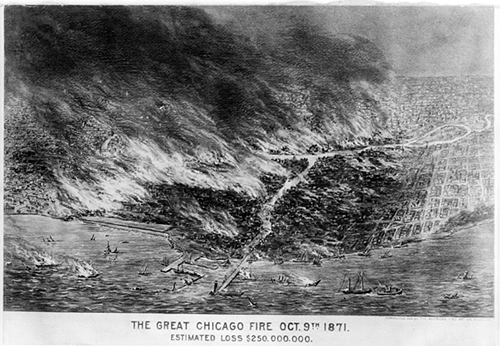
Chicago has had its share of fires. Three that come to mind are the Great Chicago Fire in 1871, the Iroquois Theater Fire in 1903, and the Our Lady of Angels School Fire in 1958. All 3 are famous, and all are tragic. 

Perhaps the most famous fire to sweep an American city – and certainly the most infamous case of farm animal arson – the Great Chicago Fire claimed up to 300 lives in 1871. After starting in a barn on a particularly dry October night, the fire spread through the Windy City's unregulated wooden structures. It wreaked miles (and millions worth) of property damage.  The Great Chicago Fire was transformative for the city of Chicago, sparking political upheavals and restoration efforts that led to a population boom in the decades to come. Of course, it also changed the way we construct, insure, and regulate buildings – and not just in the city of Chicago. After the devastation of this historic event, City Council stepped up within a year to ban wooden building materials and require flame-resistant materials instead.[ii]  

 
Aftermath of Chicago Fire - 1871
Just a few decades after the city's Great Fire, Chicago suffered another fiery tragedy when the opulent Iroquois Theatre caught fire, with 602 people trapped inside. These mass casualties inspired federal and state overhauls of codes that affect public spaces, and these codes continue to govern our theatres and other entertainment and hospitality venues to this day. Like the "unsinkable" Titanic, the "fireproof" Iroquois Theatre proved to be anything but. Tragedy struck on December 30, 1903, when a stage light sparked and ignited a curtain during a packed performance of a play. Some exit doors opened inward, but the vast majority – 27 of 30 total exit doors – were blocked with curtains or locked with strange mechanisms. The audience panicked as many failed to escape, and nailed-off vents trapped the smoke and heat inside with them. [iii]

The Our Lady of Angels School Fire is known as the deadliest school fire in U.S. history, killing 87 children and 3 nuns. Survivors and family members of this tragic fire still mourn the loss of their loved ones 60+ years later.  If any good came out of this tragedy, it is the improvements made to school safety. Today, fire drills are a regular part of the school experience, allowing teachers and students to learn what the fire alarm sounds like and practice a safe exit. [iv] ,  [v]

In 1884, the Home Insurance Company Building, designed by William LeBaron Jenney, was the original site of the world's first skyscraper. It was ten stories tall with a steel skeleton, stone curtain walls, and an elevator. It was demolished in 1929 to make way for what would then become known as the Field Building. The Field building was erected by the estate of department store magnate Marshall Field. The 44-story building was designed by Graham, Anderson, Probst & White. Construction completed in 1935; 
135 Building - 1935
it was intended to be the largest office building in the Loop. It is considered to be the last true Art Deco skyscraper built in Chicago's Loop district. It was the last major building erected in Chicago before a lull in construction brought on by the Great Depression and the Second World War. On the fifth floor are 17 panels depicting Robert Cavelier de la Salle's exploration of the area. He is believed to have made camp at this location. Considered by some to be  Chicago's Empire State Building, the building was outfitted with mail chutes in the shape of the building and is crisscrossed by pedestrian bridges.   Eventually, the building would be known as the LaSalle Bank building or simply by its address, 135 South LaSalle. 
[vi] , [vii]  

I feel very fortunate that I have never had to escape a burning building. However, I did experience a close encounter. Back in 2004, I worked on the 14th floor of the LaSalle Bank Building located in the heart of Chicago's financial district. It was December 6, 2004, about 5:45 pm… forty-five minutes past my standard quitting time. I was going to stay longer, but I was tired and decided it was time to go home, have some dinner, and relax on the sofa. I got in about 6:30 pm.  Thirty minutes later, I received a phone call from a friend of mine, checking to make sure I made it home alright. I was confused. I asked her why she thought I wouldn't have made it home? She said, "turn on the news."  

A fire had broken out on the 29th floor of the 44-story building. The building was in the process of putting in infrastructure for sprinklers at the time of the fire, but on the night of the blaze, there were no sprinklers on the 29th floor. The fire was reported about 6:30pm and continued to burn until midnight. The stubborn blaze shot flames out of the windows of the beautiful art-deco designed building along with thick, black smoke. The intense heat from the inferno caused window frames between the 29th and 30th floors to twist. Over 300 firefighters responded to the fire. In all, about 37 people sustained injury, mostly firefighters due to smoke inhalation. However, several suffered minor to serious injuries according to news reports at the time. Fortunately, there were no fatalities. Bank employees had recently participated in a safety drill, about a month or so earlier. Those individuals still in the building knew what to do. [viii]  Firefighters found everyone and led them out of the building to safety. It's important to note that none of the stairwells were locked, and fire alarm announcements provided clear and concise instructions. 

A few days before Christmas, employees were allowed back in the building on the lower floors. The upper floors remained closed for weeks. The acrid smell from the fire still hung in the air, but lessened each day. Fire and safety inspectors had gone through each floor of the building to identify the cause. Eventually, it was determined that the root of the fire was faulty wiring.  Space heaters that some people had under their desks were piled up in the middle of the floor. I found sooty boot prints from the firefighters on top of my desk as they used it as a way of accessing the windows to repel down the side of the building. They stood on the wedding cake-like tiers of the building's design to gain better access to the flames with their hoses.

I don't know how I would have reacted had I been in the building at the time of the fire. I like to think that I would have stayed calm, followed instructions, and made a safe exit out of there, but I'm glad that I never had to find out.

I have attached a couple of documentary videos below on two of the fires related to this post. Both are interesting, as well as very sad. They're approximately 10 minutes or less in length, but very informative.


 RESOURCES

Monday, March 23, 2020

LIZZIE WE HARDLY KNEW YA...

My Great-Aunt, Elizabeth Lufrano, was the youngest daughter of Michael and Saveria Lufrano. She had just turned 20-years-old on March 25, 1918. She was born and raised in Chicago, Illinois. Young and pretty, Elizabeth had her whole life ahead of her, that is, until October 19, 1918. From that moment on, whenever anyone spoke about her, she was referred to as "poor Lizzie."

Spanish Influenza. The thought of another pandemic of this magnitude is too horrific to contemplate, and yet, it almost seems imminent. The story of Spanish Flu hits home for my family. The same applies to many families across the country and the world.

The 1918 Influenza pandemic [i]  or the Spanish Flu, as it is more commonly known, affected 500,000,000 people around the world. The death toll is estimated at 50,000,000 but could be as high as 100,000,000, making it one of the deadliest epidemics in history. [1]

During the epidemic, Chicago reported more than 8,500 lives lost to the disease in just eight weeks. The virus popped up in pockets around the country in the spring of that year. It disappeared almost as quickly. The summer of 1918 was relatively disease-free. Spanish Influenza, did, however, gain a foothold in Europe and began to spread across the continent. Over one million American soldiers were sent to Europe to fight in WWI. In late August, when the infected soldiers and sailors returned from Europe to military bases all over the country, the epidemic swept the nation.

While not the first stop in the U.S., the Great Lakes Naval Training Station, just 30 miles north of the city, was the first stop for the epidemic in Chicago. Beginning on September 11, 1918, the first cases were being reported. Within a week, there were over 2,600 men in the hospital. Liberty was canceled for the men at the station on September 19, to contain the outbreak, but it was already too late. According to newspaper reports, the week ending September 28, saw 598 new cases of Spanish Influenza in Chicago and 176 deaths. The following week, over 6,000 new cases were reported and more than 600 deaths. By the end of the third week, ending October 14, the number of new cases had jumped to 11,239, with over 1,400 deaths. October 17, 1918, became known as Black Thursday in Chicago when 381 people died, and nearly 1,200 more contracted the illness in a single 24-hour period. [2]  The number of deaths was occurring faster than could be accommodated. The city ran out of hearses, and so passenger trolleys, draped in black, were used instead to collect the bodies. Precautions taken against the spread of the disease were primitive at best and mostly ineffective. Public funerals in Chicago were banned altogether, and private funerals were limited to 10 people -- including the undertaker. Public places, such as bars, dance halls, and movie theaters, were closed. Churches and schools remained open. Public spitting was cause for arrest. In the hopes of reducing rush-hour crowds on public transportation, local businesses were asked to stagger their working days.[2]

A Chicago man, Peter Marrazo, [3], was driven insane by the Flu. He barricaded his family in their apartment, and slit the throats of his wife and four children, telling police, "I'll cure them my own way!" [2] 

When it was over, there were approximately 300,000 people affected by the Spanish Influenza in Illinois. The last few reported cases of the disease occurred in the first couple of months of 1920. The epidemic ended not because any cure had been found, but because the virus mutated again. The deadly Spanish Influenza strain ceased to exist (sort of.)'  [2]   
 
Lizzie & Friends - ca 1917
Lizzie & Her  Niece, Mary - 1917


There isn't much information known about where or how Great-Aunt Lizzie contracted the disease. What is known is that she became ill on October 10, 1918, and died on October 19, 1918, at 1:00 PM. Listed as her primary cause of death is meningitis, which lasted for three days. The underlying cause…influenza. Lizzie was buried two days later on October 22 at Mount Carmel Cemetery. Since public funerals were banned, it’s assumed Lizzie had a private funeral, although there is no one left to ask. The address listed on her death certificate shows, 927 Cypress. I've never heard mention of that address, the name of the street has been changed, and the building is no longer there. Was that her home address, or an isolation center where she was placed after she contracted the disease? Again, there's no one left to ask. It’s heartbreaking to think that more is known about Lizzie’s horrible death than her life. What was her favorite color or book? What did she do for fun? Who was her best friend? Did she have a boyfriend? So many questions that will never have answers. As I work on my family tree, I will continue to search for any tidbits of information that may become available on Lizzie. For now, Elizabeth Lufrano may be gone, but definitely not forgotten.

Mar. 25, 1898 - Oct. 19, 1918


RESOURCES

[i]  americanexperience/films/influenza

1 https://en.wikipedia.org/wiki/Spanish_flu
2Chicago and the Influenza Epidemic of 1918 Gapers Block .... http://www.gapersblock.com/airbags/archives/chicago_and_the_influenza_epidemic_of_1918/
3 https://chroniclingamerica.loc.gov/lccn/sn85042243/1918-10-22/ed-1/seq-1/


Friday, March 13, 2020

FAVORITE FAMILY RECIPES… A POEM FOR THE SENSES

What does the word popular mean? Is it something familiar, every day, ordinary, or readily accepted by everyone {i.e., popular opinion or a name]? Yes, it is. Is it a person that is well-liked? Yes, it is. The word is often used as part of specific phrases: 'back by popular demand,' 'contrary to popular opinion or belief.'  There are magazine titles that use the word to catch the eye of potential subscribers (think "Popular Mechanics” or “Popular Woodworking”). Even our presidential election has a 'popular vote' versus that of an 'electoral vote.' Whatever the word means to you, the implication behind it invokes something positive, and what's more positive or popular…than food?!

I have never met a person that did not love or at least enjoy Italian food… well, I did once, but we don't speak anymore. It is one of the most popular cuisines in the world and when asked…it is often touted as a favorite amongst people of all ages and ethnicities. The most obvious reason is that it's delicious. It's beautiful to look at, smells divine, and it's delicious... [did I already say that? Well, it bears repeating].

Italian cooking is a poem for the senses. It is not just pizza or spaghetti, although that's pretty tasty. It's steeped in family history. Recipes handed down with pride from grandmothers and mothers to their daughters. It's not unusual to look further back than a couple of generations: to learn why we cook in a certain way and why we eat certain things.[1] Whole dialogs have been known to center around a particular recipe. Most of which are based on oral conversations with our elders, and therefore have a limited lifespan. Consider yourself fortunate if you find the recipe written down anywhere, like the blank pages inside a cookbook that you rarely open. That's where I found my family’s homemade ravioli recipe. It was actually more of a list of ingredients with the notation "to taste" written next to each one.

Cuisine…even the word sounds delicious. It's a style of cooking characterized by distinctive ingredients, techniques, and dishes. It's usually associated with a specific culture or geographic region. It can be as much a part of an individual's history as any known ancestor.  

Italian cuisine has a history as rich, colorful, and fascinating as the most amazing of recipes. It's no secret that the Roman Empire loved to feast, and their banquets were often representative of the various lands that it conquered. Exotic spices and ingredients from the Middle East, fish from the Mediterranean, and grains from North Africa. Of course, these were meals prepared for high society. The majority of the population's diet consisted of mainly three things and products made from them:  the vine, the olive, and cereal grains. The Mediterranean Diet is a popular trend in eating today and is based upon this diet. It is also considered and recommended as one of the healthiest diets around.  Wine, olive oil, and bread. Add a few healthy helpings of vegetables, legumes, and cheese, and this is what the people of Rome would eat daily.

Spices and dried fruit became a popular blend in the Middle Ages and are often still found in Sicilian dishes. Dried pasta is generally characterized as an Italian thing but was brought to Sicily by the Arabs. They appreciated the fact that it was easy to carry and preserve on long sea voyages. From the shores of Sicily, dried pasta made its way to Naples and Genoa, as well as France and Spain. So, contrary to what we hear about the origins of pasta, it wasn't Marco Polo that brought noodles to the Italian shores. [2]
   
Three of the most popular homemade dishes in my family center around pasta. Lasagna, ravioli, and my personal favorite… Zuppa di Pollo (chicken soup). There's nothing so comforting as a big, steaming bowl of this simple chicken broth and orzo pasta, sprinkled with freshly grated parmesan cheese, and topped with a sprig of fresh parsley or dried parsley flakes. Serve it with a piece of hot Italian bread dipped in olive oil and grated cheese or slathered in butter. Well, maybe go easy on the butter or the slathering, and you will have a cure for whatever is ailing you. 

It cannot be denied that Italian cuisine (or as it is referred to in Italy… "food") offers some of the most popular and tasty dishes imaginable. From bruschetta, pizza, pesto, pasta alla carbonara, and cannelloni to espresso, cappuccino, cannoli, and tiramisu… the popularity of these fantastic dishes is hard to beat. So, what are you waiting for?  Mangiamo! (Let's eat!)


[3] Pasta Shapes


RESOURCES:

[1] The History of Italian Cuisine I - Life in Italy. https://www.lifeinitaly.com/history-of-food/the-history-of-italian-cuisine-i

[2] The History of Italian Cuisine I - Life in Italy. https://www.lifeinitaly.com/history-of-food/the-history-of-italian-cuisine-i

[3] Pasta Shapes.  https://www.huffpost.com/entry/pasta-shapes-deathmatch_n_3416286?guccounter=1


Featured Post

From Boys to Men and (Sometimes Back Again)

Between 1906 and 1923 both my paternal and maternal families took shape: three uncles on each side, six aunts, and my parents. The maternal ...